Koliva – Wheat Berry Memorial food

The significance of koliva
Koliva is the sweet offering we make to commemorate our loved ones who have passed at their funeral or their memorial (mnimosino). As well as on some other occasions, for example during Lent. Koliva are prepared and taken to the church service to be blessed during the prayers for the dead. We then scoop them into paper bags to distribute to the church goers after the liturgy. At that point we say «Αιωνία τους η μνήμη», meaning “May their memory be eternal”. Making koliva is a common custom within the Orthodox population. I talked to a few other cultures through social media, who told me they make koliva in a similar way also.

My childhood loss
Today marks my mum’s 20 year memorial anniversary. I am in absolute disbelief that so many years have passed already. I still have the strongest memories of her and us as a family in Cyprus. She always showed us her love in one way or another but the occasions I remember the most are when we were in the kitchen together. As a young girl I would always follow her around trying to find ways I could help or just simply observe what she was doing.
The day she lost her battle with cancer we were all at my aunty’s house, running around with my cousins playing. Slowly slowly I saw people arriving dressed in black. As an eleven year old, I remember thinking it was odd but i really did not pay that much attention to it. It was only when my dad arrived, looking quite frail, that I realised that something serious happened. He took my younger sister, brother and I to one of the rooms and told us the sad news. “Your mum is up in heaven now”, he said and we all burst into tears. I’ve lived a lifetime time without her but I don’t think she’s ever left my side.

My mum actually passed away on a Good Thursday at the age of 33, exactly like Jesus Christ. So every Easter period is even more special to us as we remember her for the creative, bright, caring, resilient and determined person she was. The last few years we also lost two other strong women who were like mother figures to me, my grandmother and my mother in law. So in their honour I wanted to post my koliva recipe.
The ingredients needed for koliva

As I was researching about the meaning behind the ingredients of koliva, I was pointed to the social media page of one of the Greek Orthodox parishes – St Anargiri in Oakleigh. In the post it was written that “The wheat kernels express belief in everlasting life. Just as a new life rises from the buried kernel of wheat, we believe the one buried will rise one day to a new life with God.”
There are a variety of ways to make koliva based on the region people are from but also the season (i.e if fresh pomegranates are available). I learnt this koliva recipe from my husband’s family in Cyprus. As my father in law says, this recipe results to koliva that are «πλούσια», meaning rich with ingredients and just the perfect ratio of each for him.
Among many ingredients, typically the Greek version contains a lot of powdered sugar, walnuts, crushed rusks and a fresh herb like parsley or mint. The Cypriot koliva recipe don’t have any of those ingredients. With the lack of powdered sugar, I find the Cypriot version lighter and more nutritious.
What you can use to decorate with
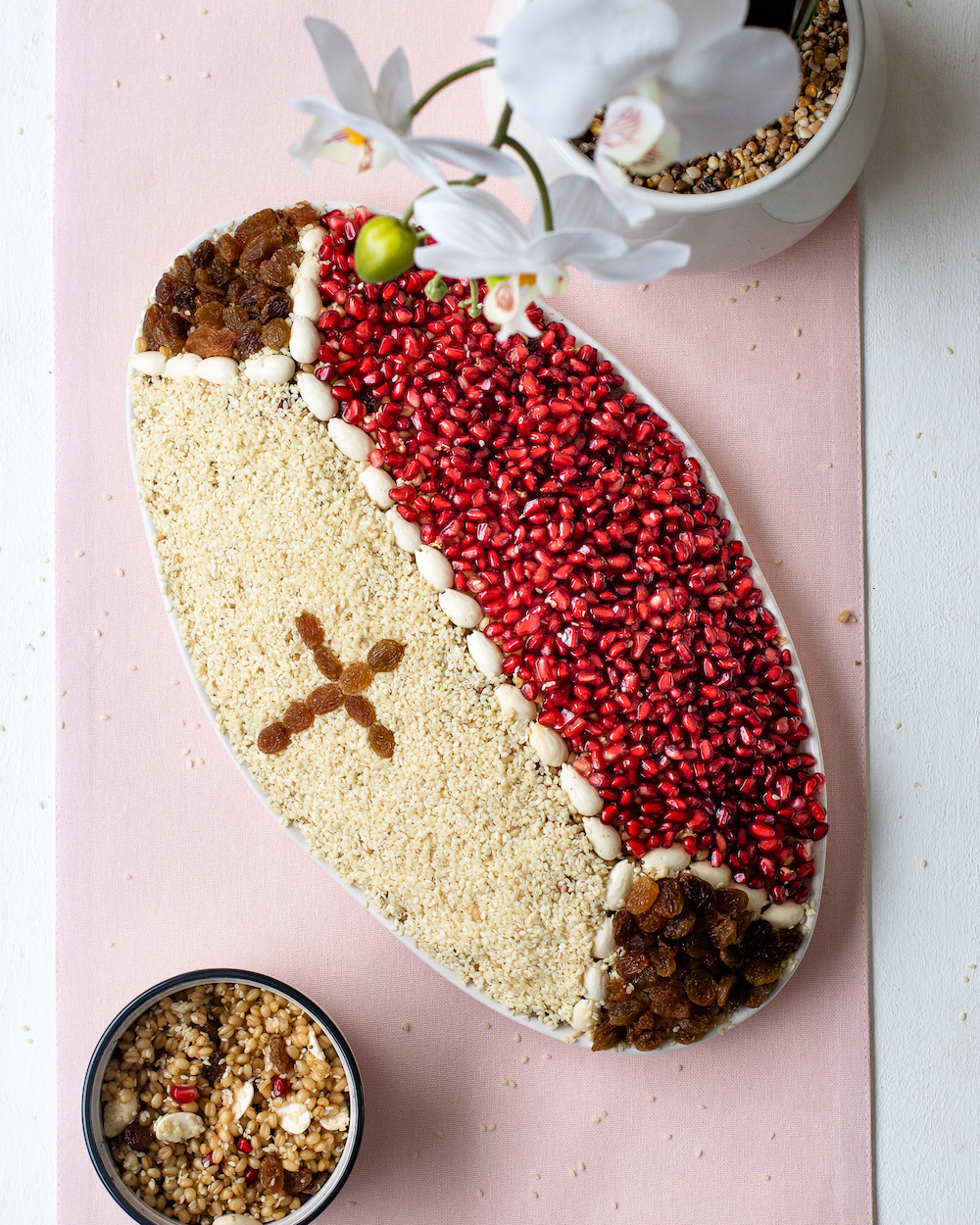
Before the ingredients are mixed you need to think about how you will decorate the koliva. As you see from my images I used some of the sesame seeds, sultanas, blanched almonds and pomegranates to decorate the tray. Then you need to keep some of those ingredients aside and mix the rest of the ingredients in a bowl. Commonly a cross and the person’s initials you are commemorating are shaped on the surface.

Once you mix the ingredients you pile them evenly on a rectangular or oval tray, which represents the shape of grave (sometimes koliva are also placed in bowls). Then you carefully decorate the surface, which may seem to be the more time consuming part. Use my image as a guide but you may get as creative as you like to complete the koliva recipe.
Tips and information
– The water used to soak the wheat and almonds is ideal to water the plants with so don’t throw it out. You can even cool the water that the wheat is boiled in and use it in the garden also.
– You may use almonds that are already peeled from the shops but I like the crispiness of freshly blanched almonds.
– To peel the almonds you need to soak them in water. Soaking almonds in room temperature water I find gives you a better result than boiling them. They keep their flavour and have a better texture.
– The better the quality of the almonds the easier and the less soaking time they will need to peel. Use the skin of the almonds you peel off in the garden as compost.

– To deseed the pomegranate I usually cut off the top, score the sides and then open the fruit to take out the seeds. You may have your own way of deseeding pomegranates but if you haven’t before watch this video here, which is of the method I usually use.
– If you are using sesame seeds to decorate the tray of koliva, they are easier to stay on if they are slightly damp, not too wet though.
– The wheat berries are an ideal environment for a bacterium called Bacillus cereus to germinate and cause enteric infections. According to the Food Safety website “Spores are dormant but germinate producing cells that can grow when they are in warm, moist and nutritious environments”. Hence once the wheat is boiled and cooled it needs to be placed in the fridge to dry.
– If you wish to prepare the koliva the night before the memorial, you can do so. Simply adjust the timeline I listed in the method and store the koliva in the fridge well covered.

For more sweet creations, traditional and non, check out this link!